

Sel Frigon
De-icing salt bulk
AN ESSENTIAL SOLUTION FOR ROAD SAFETY IN COLD SEASON
Bulk de-icing salt is one of the pillars of winter interventions on municipal road networks, industrial zones, public building access areas and open-air logistics perimeters. Used to prevent ice accumulation or treat its effects, this product acts by directly dissolving the bonds between the surface and freeze layers, lowering the freezing point of water and helping quickly restore acceptable traction conditions. Offered in bulk to meet the volumes required by institutional or contractual buyers, this salt is a core component of planned winter maintenance strategies.
Adapted to thaw cycles, freezing precipitation, surface frost or compacted snow layers, bulk de-icing salt is often the first product deployed in municipal plans, as a complement to or in alternation with other specialized formulations.
Plan the next bulk salt delivery
Optimize your supply for critical periods and ensure consistent safety across your network.
Bulk De-Icing Salt
Physical characteristics and mode of action
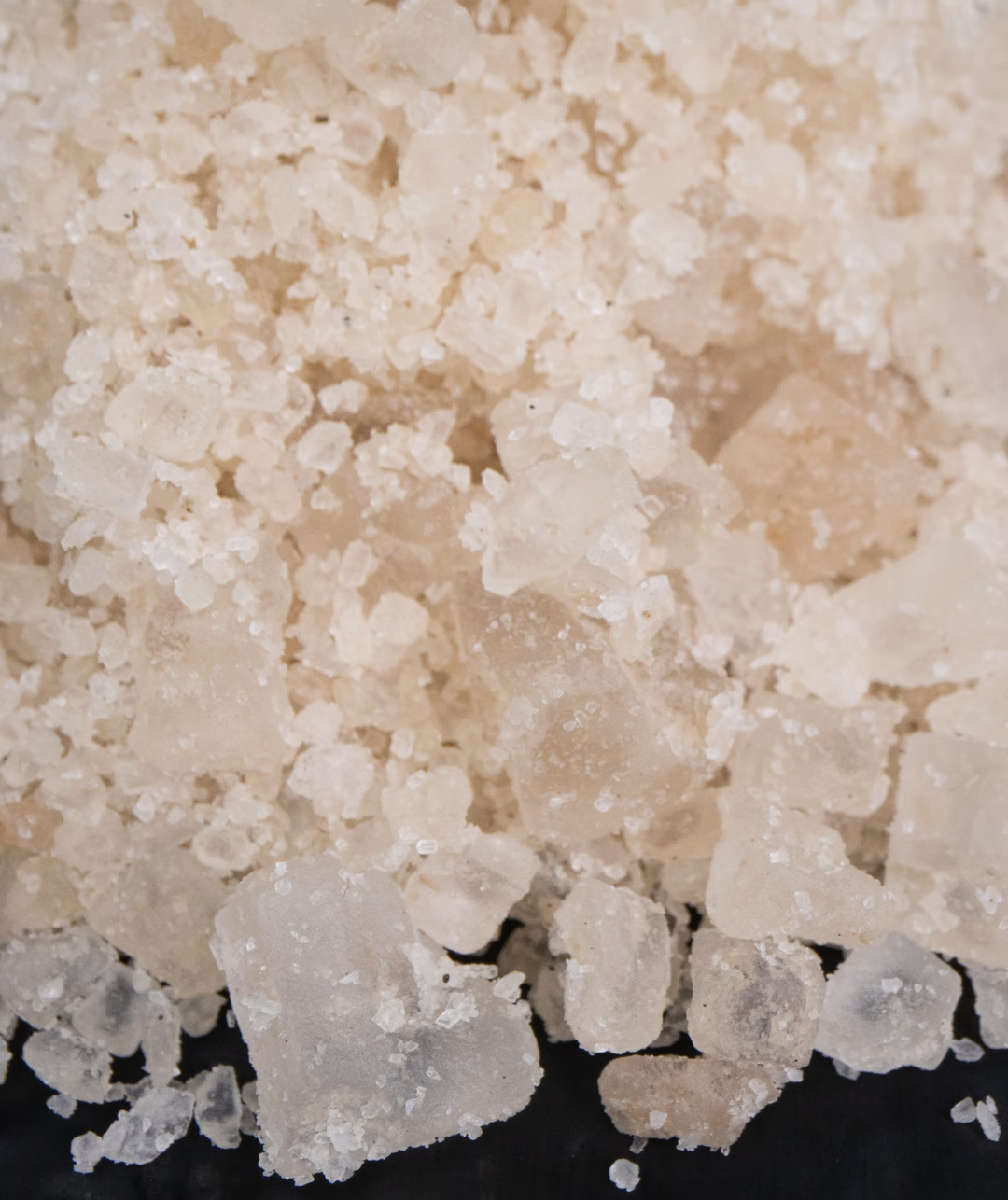
The salt used is natural or refined sodium chloride, calibrated to ensure uniform gradation that allows mechanical application without blockage or segregation.
Its density, residual moisture rate and crystalline structure directly influence its ability to activate quickly upon contact with ambient moisture.
Once spread, the product absorbs water present on the surface or generated by condensation or partial melting, then initiates a dissolution process by lowering the freezing point of the resulting solution.
This phenomenon allows ice to detach from the roadway and creates a brine film that helps prevent rapid refreezing.
Salt effectiveness is optimal in temperature ranges from -1 °C to approximately -12 °C. Beyond that, the product can still be applied, but its effect will depend on ambient moisture and the thermal capacity of the surface.
Bulk De-Icing Salt
Use contexts in municipal and industrial networks
Bulk de-icing salt is widely used on paved roads, main arteries, access ramps, critical intersections and entrances to public-facing buildings.
It is also common in plant parking lots, logistics ramps, industrial traffic areas and technical service roads.
In municipalities, it is generally part of the first intervention level on priority segments, securing the most sensitive traffic areas from the start of an adverse weather event. It is often stored in large volumes at municipal depots, with replenishment based on anticipated precipitation cycles or overnight freezing.
In the industrial sector, it is frequently used to maintain access to loading docks, avoid delays in outdoor handling operations or limit production stoppages caused by unusable peripheral zones.
Bulk De-Icing Salt
Performance parameters and effectiveness limits
Salt performance depends on several combined factors: ambient temperature, surface moisture level, wind speed, traffic over the treated area and product gradation. Under optimal conditions, melting begins within minutes, and the effect can last several hours depending on roadway thermal stability.
However, as temperatures fall below -12 °C, salt’s melting power decreases. In these situations, calcium chloride treatment or a treated product may be considered.
It is also common to complement application with sand to ensure a minimum level of friction in risk areas (slopes, curves, curve exits).
Spreading dosage is generally between 10 and 40 g/m² depending on condition intensity. Homogeneity of the spread layer is a key performance factor, which makes good compatibility between the product and equipment important.
Bulk De-Icing Salt
Bulk storage, handling and spreading
De-icing salt is delivered in bulk to storage sites designed for this purpose: municipal domes, ventilated silos, covered sheds or outdoor concrete areas under tarp. It can be handled by loader, conveyor, auger or loaded directly into hopper spreaders.
Products supplied by Sel Frigon are calibrated to ensure granular stability during transport and storage, minimizing losses through leakage, clogging or compaction.
The moisture rate is adjusted to avoid runoff or agglomeration issues while ensuring good application behaviour.
Bulk supply is the most efficient logistics solution for organizations managing large linear networks or large surface volumes to treat, reducing repeated handling and ensuring operational continuity throughout the winter season.
Understand Sel Frigon’s logistics capacity
Discover how our expertise and supply consistency support municipal and industrial operations throughout Québec.
Sel Frigon
Integration into an overall winter strategy
Bulk salt is often considered the base product in a multi-level winter maintenance architecture. It can be used preventively before a forecast event, correctively after precipitation or as support treatment in continuous spreading cycles.
Its integration into a multi-product strategy allows modulation according to conditions: used alone for moderate-temperature roadways, combined with sand for friction zones or alternated with treated products during periods of extreme cold. Municipal services and contractors often establish territorial segmentation according to the type of de-icer used, with dry salt reserved for segments that must be cleared quickly and at a high cadence.
It is also compatible with pre-wetting protocols, where a liquid treatment is applied before dry salt to increase its adhesion and initial effectiveness.
Bulk De-Icing Salt
Our FAQ
To learn more about our product
At what temperature does de-icing salt become ineffective?
Standard salt loses effectiveness below -12 °C. Below this threshold, it may be necessary to use a treated product or a more active de-icer.
Can this product be used on sidewalks or pedestrian zones?
Yes, provided the dosage is adapted and local guidelines for maintaining publicly accessible surfaces are respected.
What is the recommended application rate for bulk salt?
Usual doses vary between 10 and 40 grams per square metre, depending on temperature, ice intensity and surface type.
Can salt be combined with an abrasive?
Yes, it is frequently used with sand or fine stone in areas where immediate traction is a priority.
Is bulk salt compatible with pre-wetting?
Yes, adding a liquid before spreading improves granule adhesion and accelerates activation on the roadway.

For more than two decades, Sel Frigon has handled shipload imports and de-icing salt distribution across Québec, supporting the operations of municipalities, industries, contractors and public institutions.